
The Evolution of Dart Equipment Over the Last 20 Years
Darts might look like a simple pub game, but over the last two decades, the equipment behind it has gone through a quiet revolution. From dartboards and barrels to flights, shafts, and even scoring systems, almost every part of the game has evolved.
What used to be a basic setup of a bristle board and steel darts has now turned into a highly engineered, precision-driven sport supported by advanced materials, manufacturing techniques, and even digital technology.
This blog explores how dart equipment has changed over the last 20 years—and why those changes matter for beginners, casual players, and professionals alike.
🎯 1. Dartboards: From Traditional Bristle to Smart Systems
🟤 Early 2000s: Classic Bristle Boards
Two decades ago, most players used traditional sisal bristle dartboards. These boards were:
- Made from compressed sisal fibers
- Durable but inconsistent over time
- Prone to “bounce-outs” if darts didn’t land perfectly
The design was simple and unchanged for years.
🟢 Today: Advanced Bristle + Smart Boards
Modern dartboards have improved significantly:
- Thinner wiring systems to reduce bounce-outs
- Staple-free bullseyes for cleaner scoring
- Higher-density sisal for longer life
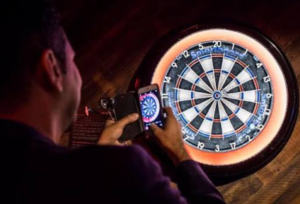
Even more importantly, we now have smart dartboards that include:
- Sensor-based scoring
- App connectivity
- Automatic match tracking
Target Darts Pro Series Dartboard and other premium boards reflect how far traditional designs have been refined.
🎯 2. Dart Barrels: Precision Engineering Takes Over
🟤 Then: Basic Brass and Nickel Silver
In the early 2000s, most darts were:
- Brass barrels (cheap and beginner-friendly)
- Nickel silver for intermediate players
- Limited grip design options
Players often relied more on feel than precision engineering.
🟢 Now: Tungsten Revolution
The biggest change in darts has been the shift to tungsten barrels.
Why tungsten changed everything:
- Higher density = thinner darts with same weight
- Better grouping on the board
- Improved balance and aerodynamics
Modern professional darts are typically:
- 80%–97% tungsten
- CNC-machined for perfect symmetry
- Designed with micro-grip textures
Top-level players now choose darts based on millimeter-level grip patterns rather than just weight.
🪶 3. Flights: From Basic Shapes to Aerodynamic Science
🟤 Early Designs
Flights used to be simple:
- Standard shapes (No. 2 or No. 6)
- Basic plastic material
- Limited durability
They often tore quickly and affected consistency.
🟢 Modern Innovations
Today, flights are engineered for performance:
- Poly metronic and carbon-infused materials
- Shape variations (kite, pear, slim, standard)
- Integrated flight-shaft systems
Some systems now lock the flight and shaft together for stability, reducing wobble during flight.
This has made darts more predictable and consistent, especially for high-level players.
🪵 4. Shafts: Lightweight Strength Evolution
🟤 Earlier Shafts
Traditionally, shafts were made from:
- Aluminum (strong but heavy)
- Basic plastic (cheap but fragile)
Breakage was common, especially during tight groupings.
🟢 Modern Shafts
Now, shafts are:
- Made from nylon composites or carbon fiber
- Designed with anti-vibration properties
- Often include locking mechanisms for flights
These improvements help players maintain consistent throw dynamics, especially during long matches.
⚖️ 5. Dart Weights & Customization Trends
🟤 Then: Limited Options
Most players used standard weights:
- 18g–24g soft tips
- 20g–26g steel tips
Customization was minimal.
🟢 Now: Highly Personalized Setup
Players now fine-tune:
- Barrel weight distribution
- Grip texture zones
- Balance points (front, center, rear-heavy darts)
Manufacturers now offer custom fitting systems where players can test different setups before purchasing.
This level of personalization has made darts more technical than ever.
🎮 6. Soft Tip vs Steel Tip Technology Improvements
🟤 Early Soft Tip Systems
Soft tip darts in the 2000s were:
- Basic plastic tips
- Simple electronic boards
- Limited game modes
🟢 Modern Electronic Systems
Today’s systems include:
- Auto-scoring sensors
- Multiplayer online connectivity
- Game variety (Cricket, 501, AI challenges)
Soft tip darts have become more competitive and tech-driven, especially in Asia and entertainment venues.
Steel tip remains dominant in professional competition, but soft tip has gained a strong recreational ecosystem.
🧠 7. Rise of Data-Driven Dart Training
One of the biggest changes isn’t physical equipment—it’s data integration.
Modern players now use:
- Throw tracking apps
- Heat maps of accuracy
- Performance analytics dashboards
This shift has transformed darts into a measurable sport.
Players can now analyze:
- First-9 average
- Checkout percentage
- Miss patterns
- Consistency under pressure
What was once instinct-based is now science-backed.
📱 8. Smart Technology Integration
The last decade has introduced smart systems that didn’t exist before:
- Bluetooth dartboards
- AI coaching apps
- Online leagues
- Live stat tracking
These systems help players:
- Train more efficiently
- Compete globally
- Track long-term improvement
Darts has officially entered the digital sports era.
🏆 9. Professional Equipment Evolution
Professional darts today are extremely advanced compared to 20 years ago:
- Laser-balanced tungsten barrels
- Custom grip mapping
- Flight stabilization systems
- Precision testing during manufacturing
Even small adjustments—like a 0.1g change in weight distribution—can affect performance at the top level.
Manufacturers now collaborate with professional players to design signature darts tailored to individual throwing styles.
📊 10. Key Changes Over 20 Years (Summary)
| Category | 2000s | Today |
|---|---|---|
| Dartboards | Basic bristle | Smart + improved bristle |
| Barrels | Brass/nickel | Tungsten precision |
| Flights | Standard plastic | Aerodynamic engineered |
| Shafts | Aluminum/plastic | Carbon/nylon composites |
| Scoring | Manual | AI + digital |
| Training | Experience-based | Data-driven |
🔮 Final Thoughts
The evolution of dart equipment over the last 20 years shows a clear trend: precision, customization, and technology integration.
What was once a simple pub game has become a highly engineered sport where every millimeter matters. From tungsten barrels to AI-powered dartboards, the modern game rewards not just skill—but also smart equipment choices.
Yet, despite all the innovation, the core of darts remains the same:
- Aim
- Focus
- Consistency
The tools may have changed dramatically, but the challenge of hitting the bullseye is still as exciting as ever.



Add comment